Helmet Camera UK Guide: Legality, Mounts and Safe Setup
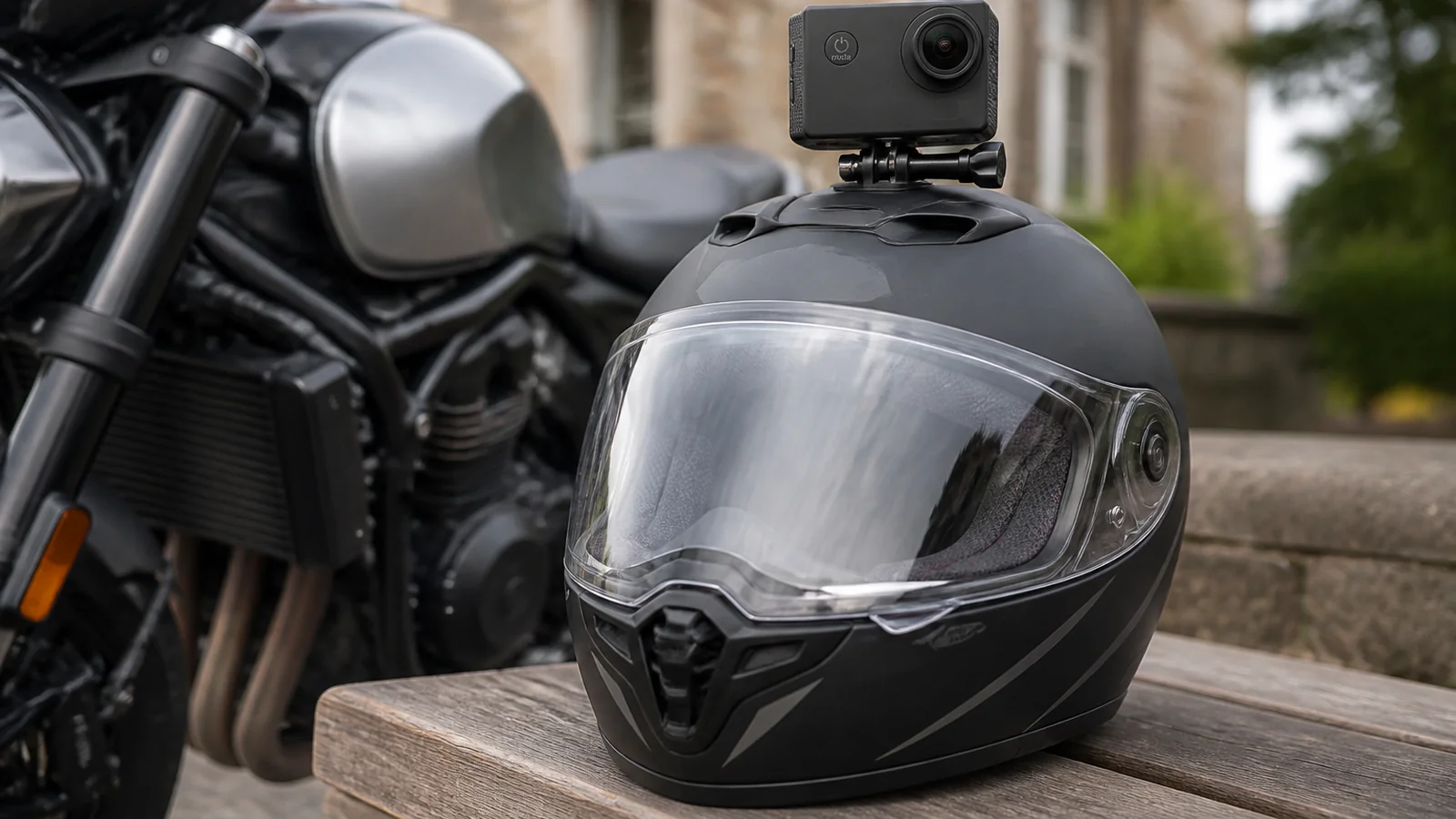
Short answer: Yes — wearing a helmet camera is legal in the UK for motorcyclists and cyclists. Filming in public places is permitted and needs no licence, and courts and insurers routinely accept helmet-camera footage as evidence. The two rules that actually matter: mount the camera with a proper bracket or adhesive mount rather than drilling the shell, and keep original clips unedited if you may ever need them as evidence.
Are helmet cameras legal in the UK?
There is no UK law against wearing a camera on a motorcycle or cycle helmet, and no permit is needed to record in public — the same principle that makes dashcams lawful. What the law and safety guidance care about is how the camera is attached and what you do with the footage afterwards.
One practical caveat riders trip over: the camera must not interfere with your vision or the helmet's ability to protect you. Keep the unit compact, positioned away from your eyeline, and tethered so it cannot swing loose at speed.
Will it affect your helmet or your insurance?
Two separate questions, both answered by checking rather than assuming.
Helmet integrity. Never drill or screw into a helmet shell — that weakens the structure the helmet exists to provide. Use the bracket, curved adhesive mount or strap mount supplied for your camera, and follow your helmet manufacturer's guidance for your specific model. If a mount will not hold without modifying the shell, change the mount, not the helmet.
Insurance. Policies differ. Camera footage is widely used to support claims, and clear POV video can settle a liability dispute quickly; some insurers view riders who record favourably. But whether a stick-on camera counts as a notifiable helmet modification varies by insurer, so check your policy wording or ask directly — treat anything an insurer tells you verbally as worth having in writing.
Footage as evidence: what it can and cannot do
Helmet-camera video is generally admissible in civil claims and criminal proceedings, and many UK police forces run online portals where riders and cyclists can upload clips of dangerous driving. To keep footage useful:
- Keep the original file unedited — trimming or re-encoding can undermine it as evidence.
- Note the date, route and any witnesses separately while memory is fresh.
- Expect the police to be able to request or seize footage if they believe it records an offence — that can include your own riding.
- Be realistic about coverage: a forward-facing camera cannot prove what happened behind you.
Privacy: what you can film and what you should publish
Recording in public for personal safety is lawful and needs no announcement. Publishing is where judgement comes in: blur or avoid identifiable people and number plates when posting routine clips online, be careful presenting footage in ways that accuse identifiable people, and delete routine recordings you do not need — keeping only dated incident files is both good practice and good data hygiene.
Mounting that actually holds in British weather
Wet, cold conditions are hard on adhesives, so fit mounts indoors at room temperature and give the pad 24 hours to cure before riding. Then choose the position:
Chin mount (full-face helmets) — closest to your natural eyeline, shows bars and mirrors, and records what you actually saw: the most persuasive angle for evidence. Use a damped arm on coarse tarmac.
Top or side mount — easier on open-face and cycle helmets; slightly higher viewpoint and more wind noise against the housing.
Bar or fork mount — kindest to vibration and wiring, but it does not turn with your head, so it may miss the thing you looked at.
Whatever the position, add the tether. A camera that parts company with a helmet at 60mph is a hazard to everyone behind you — and cold, damp mornings are exactly when adhesive pads let go. The G200R bundle ships with helmet mounts, tethers and clips in the box, so you can test chin and top positions before committing.
Five-minute safe-setup routine
- Confirm the bracket is camera-maker supplied or compatible — no shell drilling, ever.
- Fit the tether to both camera housing and a secure anchor point.
- Check the mount has not stiffened or lifted after cold nights; press adhesive edges before each ride.
- Record a one-minute test clip in the driveway and check the angle covers your eyeline.
- File any incident clip the same day with date and route; delete routine footage weekly.
Camera settings — resolution, frame rates, loop recording and exposure for number plates — are a riding-craft topic of their own: our action camera for motorbike UK guide covers them in detail.
Why the G200R bundle suits a first helmet-camera setup
For riders interested in a first helmet-camera setup, the G200R bundle at £88.84 includes 4K/30fps and 1080p/30fps recording, a waterproof housing rated to 30m, one 900mAh battery, dual charger, wireless remote, mounting accessories and a 64GB TF card. The camera has no electronic image stabilisation, so test the mount for vibration before riding. The site offers free UK delivery, 90-day returns and a 12-month warranty.
Frequently Asked Questions
Is it legal to wear a helmet camera on a motorbike in the UK?
Yes. No law prohibits helmet cameras for motorcyclists or cyclists, and recording in public is lawful. Mount with a bracket or adhesive mount rather than drilling, and make sure the camera does not obstruct vision or compromise the helmet.
Can helmet camera footage be used against me?
It can. Footage is admissible evidence in both directions, and police can request or seize recordings they believe show an offence — including your own. Ride as if the camera is always on, because it is.
Do I have to tell people I am filming?
Not for personal recording in public places. If you publish footage, avoid identifying individuals unnecessarily, and take particular care with clips that could accuse someone of an offence.
Will a helmet camera void my motorbike insurance?
Usually no, but policies vary on helmet modifications and attachments. Check your wording or ask your insurer in writing — and remember footage often helps claims far more than a mount ever complicates them.